
|
New demands for increased fuel efficiency, lower emissions and improved passenger comfort are changing how automobile manufacturers approach vehicle design, presenting an array of challenges for the industry at large and mechanical testing specifically. For the past decade, Byron Saari, Principal R&D Engineer at MTS Systems, has been focusing on the testing challenges. “It started with some really interesting inquiries from leading-edge damper, or shock absorber, suppliers about 10 years ago,” Saari said. “They asked about an NVH system that would be suitable for testing a structure-borne noise phenomenon called “chuckle.” It turned out to be a tall order.” |
|
|
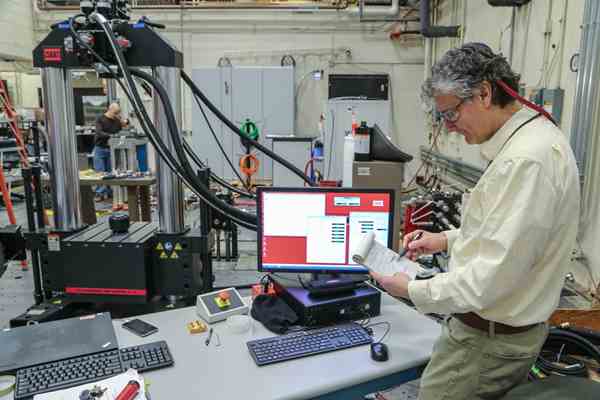
Byron Saari is integrating elastomer testing technology (foreground) and linear electro-magnetic actuation (background) to develop an effective means for studying structure-borne chuckle. |
|
|
What Saari was witnessing was the emergence of market forces that would soon complicate noise, vibration, and harshness (NVH) testing for dampers. The rise of autonomous vehicles, for example, is putting greater emphasis on ride and comfort. Lighter vehicles and quieter powertrains have improved fuel efficiency and reduced emissions but have also made it more difficult to control noise generated by (and transmitted by) the shock absorbers. In fact, now that powertrain, drivetrain, and aerodynamic noise have all been thoroughly reduced, residual damper noise is more prominent. While airborne “swish” is comparatively easy to identify and mitigate at the component level, structure-borne chuckle noise presents a more troubling issue. Chuckle (also called “clatter,” “rumble,” and “trunk of lumber”) has yet to be fully understood. It originates as a mechanical vibration in the body of the shock absorber. Impedance coupling in the upper mount turns the mechanical vibration into acoustic noise in the cab. As such, chuckle is model- or platform-dependent and cannot be easily identified or resolved at the component level. Serious chuckle problems are often discovered during the prototype phase and can be extremely disruptive to the vehicle development budget and schedule. Chuckle presents unique challenges for mechanical testing as well. Unlike swish analysis, chuckle testing has no standardized equipment or procedures. The phenomenon is difficult to replicate in the test lab because it is not always clear what noise signature will cause an issue. “Even if you can isolate a frequency that causes chuckle for a particular shock absorber, you may not be able to replicate it in a different test bench due to existing test system resonances,” Saari said. “All of these issues make it very difficult for damper suppliers to meet OEM specifications for damper noise in the cab. As a result, NVH testing has become a much more critical part of the development process.” Conventional damper test equipment is not well suited for characterizing chuckle. The mechanical vibration needs to be measured with an accelerometer at the top of the damper rod, which is difficult to do at high frequencies without the test rig influencing the results. In addition, damper test systems are typically used to run tests with a maximum input (sinusoidal or road data) of 25 Hz. If higher frequencies are unintentionally excited in the test system, it is generally not a concern. Unfortunately, chuckle happens at frequencies from 200 Hz to 500 Hz. If a 25 Hz sinusoid excites a 250 Hz harmonic, for example, it will be measured in the output of the piston rod. Analyzing this data would lead developers to conclude that the damper design has a 250 Hz chuckle problem, when in fact this is an effect of the harmonic distortion of the test system’s excitation. “To be truly effective at analyzing chuckle, a damper NVH solution needs to provide very pure sinusoidal excitation with very little total harmonic distortion, or THD,” Saari said. As it turns out, Saari is uniquely positioned to develop such a solution due to his many years at MTS spent researching and developing servohydraulic test systems for both damper and elastomer test applications. His work with customers worldwide helped shape both portfolios of products for the company, and he acquired deep domain expertise in the nuances of these complex tests. With insight from both domains, Saari envisioned a new test system design for studying damper NVH, one that would combine the capabilities of an elastomer test system with those of a damper test system. In 2014, MTS acquired Roehrig Engineering, Inc., developer of all-electric EMA damper test systems - renowned for high frequency response and programmability. The addition of linear Electro-Magnetic Actuation (EMA) technology provided the spark to set the new damper NVH solution in motion. The realization of Saari‘s damper NVH vision, then, would represent a fusion of conventional MTS elastomer with damper technologies and electro-magnetic actuation. |
|
|
The Model 853 NVH Damper System draws from servohydraulic damper (left), linear electro-magnetic damper (middle) and servohydraulic elastomer (right) test technologies. |
 |
|
To perform damper NVH measurements with fidelity and accuracy up to the required 700 Hz, the system would employ high-bandwidth transducers that are typically used to measure displacement, force, and vibration in high-frequency elastomer test systems. It would also need an elastomer test system’s high-stiffness load frame, along with larger diameter columns, a thicker crosshead, and a more robust base to avoid the resonant modes that can corrupt measurements. |
|
|
The first modal frequency affecting data measurements of interest is above 700 Hz. |
 |
|
Linear EMA technology is an ideal source for the clean sinusoidal input and low harmonic distortion the system would require for effective chuckle testing. MTS’ EMA technology combines fixed, high-force neodymium magnets and moving air-core (ironless) electric motors. The lack of ferrous metal makes the motor extremely lightweight, which is what enables the actuator’s high frequency response and high acceleration. The ironless motor also means there is no attractive force between the motor and the magnet and therefore no risk of cogging effects that can compromise the velocity waveform. |
|
|
Command (blue) vs. Response (red), indicating low Total Harmonic Distortion (THD) for a 15 Hz excitation. |
 |
|
The result of this fusion is the Model 853 NVH Damper System – purpose-built for NVH testing of dampers and shock absorbers. Specification-wise, the system will perform measurements with fidelity and accuracy up to 700 Hz. It will be rated at 15 to 20 kN, deliver 3 m/s simultaneous dynamic force and velocity and 1 kN static force standard with optional increased capacity. Versatile FlexTest® controller technology will make the system capable of reproducing virtually any type of signal (sine block, sweeps, road signals). In addition, high bandwidth PIDF (Proportional Integral Derivative Feedforward) control will enable it to follow a specified wave shape precisely without iterations. |
|
|
The Model 853 NVH Damper System – purpose-built for NVH testing of dampers and shock absorbers. |
 |
|
Saari believes the Model 853 will help test labs perform chuckle testing more easily, address the entire range of standard damper noise phenomena, including swish and squeak, perform basic damper characterization, and even provide elastomer testing functionality. “This new system will be an important advance in the field of NVH testing,” Saari said. “It fills a critical gap in damper test labs and gives test teams the standardized equipment necessary to address a persistent issue in the development cycle.” |
|
Adapting to Evolving Damper NVH Requirements
Learn how state-of-the-art MTS damper test solutions can benefit your new vehicle development.
Contact your MTS RepresentativeResources
Model 853 Damper NVH System
Analyze the complete spectrum of damper noise and vibration …
Pruebas NVH para amortiguadores
Diseño de última generación de sistemas NVH para amortigu…
Factores que hay que considerar cuando se piensa en sistemas de prueba eléctricos o hidráulicos
Orientación sobre sistemas de prueba de amortiguadores y …
Pruebas de la suspensión de bicicletas de alto rendimiento
Visite el laboratorio de pruebas de Fox Factory, Inc. para v…
Desarrollo acelerado de sistemas activos y semiactivos
Explore las ventajas de la tecnología probada mHIL.
Nissan Motor Co., Ltd.
Uso de la simulación híbrida para evaluar el impacto del sis…
Presentamos los controladores FlexTest Elite Performance
Aumente el número de canales, la velocidad del sistema y …
El camino hacia RPC Connect
Cody Johnson analiza el software RPC: pasado, presente y fut…
Vista previa del software RPC Connect: Seminario web 1
Safa Mogharebi analiza la nueva interfaz gráfica de usuario
Vista previa del software RPC Connect: Seminario web 2
Safa Mogharebi analiza las nuevas etapas de configuración y …
Vista previa del software RPC Connect: Seminario web 3
Safa Mogharebi analiza las nuevas etapas de modelado y simul…
Diseño de banco de pruebas
Cree sus propios bancos de pruebas de componentes y subsiste…
Sistemas Flat-Trac de nueva generación
Los motores de imán permanente MTS mejoran la capacidad d…
Presentamos un simulador de carretera totalmente eléctrico y con capacidad de durabilidad, el modelo 320, que se acopla a los neumáticos
Presentamos el Actuador eléctrico lineal con núcleo de hi…
Llevando las pruebas de neumáticos a un territorio inexplorado
El NTRC equipa la instalación de pruebas de neumáticos má…
Velocidad de muestreo óptima para sistemas servohidráulicos
Brad Thoen analiza cómo la frecuencia de muestreo del sistem…
National Tire Research Center (NTRC): Transformando el diseño de los neumáticos
El sistema de prueba de neumáticos de MTS de alta potenci…
La promesa de las pruebas virtuales
Utilizar herramientas de análisis para obtener información p…
Nuevas clases de capacitación en línea disponibles
Cursos introductorios en directo, impartidos por un instruct…
Seminario europeo de vehículos todo terreno
Conozca las tecnologías y los …
Pruebas de durabilidad de camiones pesados
Explore las tecnologías y métodos de prueba de camiones p…
Prueba de chasis
Soportes de prueba de componentes GNTP y casquillos NVH. …
Pruebas de neumáticos para camiones ligeros y de carreras
Sistema de medición de fuerzas y momentos Flat-Trac LTRe<…
El sistema de 4 postes correcto: ¿Servohidráulico o eléctrico?
Factores que hay que considerar al comparar servohidráuli…