お問い合わせ
  • 産業
    • 自動車
      • Passenger Cars & Light Trucks
      • ドライバー支援 & 自動運転車
      • 電気の & 新エネルギー車
      • Heavy Trucks & Commercial Vehicles
      • Off-Highway Vehicles (OHV)
      • レーシング & モータースポーツ
      • RV車
      • オートバイ
      Automotive

      Automotive

      320 kph

      flat-belt roadway enables precise replication of motorsports cornering maneuvers

      Read the Case Study
    • 材料
      • Metals
      • コンポジット
      • Plastics
      • ゴム & エラストマー
      • 接着剤
      • Concrete & Rock
      • Ceramics & Glass
      • テキスタイル
      • 木材
      • 紙製品
      • 大学
      Materials

      Materials

      1500 degree Celsius

      solutions for testing high-temperature alloys, composites, ceramics and polymers

      Read the Article
    • 航空宇宙
      • 固定翼航空機
      • ヘリコプター & 回転翼航空機
      • Space Structures
      Aerospace

      Aerospace

      20% increase

      in testing speeds using state-of-the-art cross-coupling compensation technology

      Read the Article
    • 生物医学
      • 整形外科
      • 医療機器
      • 歯科
      • 病院 & 大学
      Biomedical

      Biomedical

      1 in 1,000 children

      will need corrective scoliosis surgery

      Read the Case Study
    • 土木工学
      • マルチハザードエンジニアリング
      • 地震工学
      • Structural Engineering
      Civil Engineering

      Civil Engineering

      1.32 million pound

      force capacity enables the testing of very large specimens all the way to failure

      Read the Case Study
    • ロック地質力学
      • Fossil Fuels
      • 地熱エネルギー
      • Mining
      • 建設
      • 炭素隔離
      • 研究
      Rock Geomechanics

      Rock & Geomechanics

      3x stronger

      concrete materials make it possible to carry higher loads

      Read the Case Study
    • エネルギー
      • Wind Energy
      • 油 & ガス
      Energy

      Energy

      56 MNm

      overturning moment capacity enables testing of the largest wind turbine drivetrains

      Read the Article
    • レール
      • Commuter Trains
      • 貨物列車
      • 高速列車
      Rail

      Rail

      550 kph

      test system enables lab-based studies of high-speed rail operating environments

      Read the Article
  • アプリケーション
    • 材料アプリケーション
    • テストタイプ
      • Tension
      • Compression
      • 倦怠感 & 骨折
      • たわみ & ベンド
      • せん断、剥離 & 涙
      • ねじれ
      • 非接触ひずみ測定
      • 高温
      • バイアキシャル & マルチアキシャル
      • 高レート
      • 動的粘弾性分析

      Material Applications by Material

    • 試験基準
      • ASTM Test Standards
      • ISO試験規格
      • EN Test Standards

      Material Applications by Material

    • 材料
      • 金属
      • Composites
      • プラスチック
      • ゴム & エラストマー
      • 接着剤
      • ファスナー & 溶接
      • コンクリート & 岩
      • Ceramics & Glass
      • 木材 & 紙製品
      • アディティブマニュファクチャリング

      Material Applications by Material

    • 自動車用途
      • Full Vehicle
      • Axle & Suspension
      • ステアリングシステム
      • Drivetrain
      • Dampers
      • エラストマーマウント & ブッシング
      • タイヤ
      • Exhaust System
      • ボディマウントコンポーネント
      • Cooling System Components
      • 交通手段 & 包装
      • Motorcycle
      • 農場、建設、オフハイウェイ車両(OHV)

      Automotive

    • 航空宇宙アプリケーション
      • Complete Full-Scale Structures
      • サブアセンブリ
      • サブシステム
      • 飛行制御システム
      • 機体コンポーネント
      • 回転翼コンポーネント
      • ガスタービンエンジン部品

      Aerospace

    • 生物医学的応用
      • 整形外科
      • 生体力学
      • 医療機器
      • 生体材料

      Biomedical

    • 土木工学アプリケーション
      • 土木構造物
      • 構造サブアセンブリ & コンポーネント
      • 非構造システム
      • オフショア & 沿岸 Terrain/Infrastructure
      • Construction Materials

      Civil Engineering

    • エネルギーアプリケーション
      • 風力タービンのテスト
      • Oil & Gas Pipeline

      Energy

    • ロック地質力学アプリケーション
      • 化石燃料
      • 地熱
      • 核廃棄物貯蔵

      Rock Geomechanics

    • 鉄道アプリケーション
      • 鉄道車両サスペンションコンポーネント
      • Rail Car Coupler
      • 鉄道車両の車輪 & レール
      • 鉄道車軸
      • Rail Car Bogies
      • 完全な鉄道車両
      • 鉄道車両のパンタグラフ
      • Railway Track & Road Bed
      • Catenary & Trolley Wire

      Rail

  • 製品
    • 自動車システム
      • フルビークルテストシステム
      • Subsystem & Component Test Systems
      • タイヤテストシステム
      • ダンパーテストシステム
      • Elastomer Test Systems
      • ハイブリッドシミュレーションソリューション
      • Modular Components

      Automotive

    • 材料試験システム
      • 静電気試験システム
      • Dynamic Materials Test Systems
      • Extensometers
      • グリップ
      • 備品 & プラテン
      • かまど、チャンバー & 流体浴
      • 高温サブシステム & TMF
      • Load & Torque Cells

      Materials

    • 航空宇宙システム
      • ターンキーコントロール & データ収集
      • Turnkey Hydromechanical Power Distribution
      • Test Article Safety Solutions
      • シリーズ261構造圧力テストコントローラー
      • ハイフォーステストシステム
      • モジュラーコンポーネント
      • FlexDAC Data Acquisition Systems

      Aerospace

    • 生物医学システム
      • 整形外科試験システム
      • Biomechanic Test Systems
      • 医療機器試験システム
      • 生体材料試験システム

      Biomedical

    • 土木システム
      • Seismic Simulators & Shake Tables
      • 多軸サブアセンブリ構造試験システム
      • ハイブリッドシミュレーションソリューション
      • 波発生器
      • 免震支承試験システム
      • ハイフォーステストシステム
      • モジュラーコンポーネント
      • STEX Pro Software

      Civil Engineering

    • エネルギーシステム
      • Wind Turbine Blade Fatigue Systems
      • 風力タービンブレード静的システム
      • Non Torque Loading System
      • 油 & ガス管 / カップリングテストシステム
      • High-Force Test Systems
      • モジュラーコンポーネント

      Energy

    • 岩 & 地質力学システム
      • 岩石力学試験システム
      • Polyaxial Rock Test System

      Rock Geomechanics

    • 鉄道システム
      • エアスプリングテストシステム
      • Railway Damper Test System
      • Rolling Contact Fatigue (RCF) System
      • 4-28チャンネルボギーフレームテストシステム
      • ボギー振動 & 特性評価システム
      • パンタグラフウェア & パフォーマンスシステム
      • High-Force Test Systems
      • ダンパー耐久性試験システム
      • エラストマー試験システム
      • モジュラーコンポーネント

      Rail

    • システムコンポーネントのテスト
      • アクチュエータ & サーボバルブ
      • SilentFlo™ Hydraulic Power Units
      • 295油圧サービスマニホールド
      • スタンド & フレーム
      • 耐荷重コンポーネント
      • FlexTest®コントローラー
      • FlexDACデータ収集
      • SWIFT® Evo Wheel Force Transducers

      Test System Components

    • ソフトウェア & モニタリング
      • RPC® Connect Software
      • TestSuite™ソフトウェア
      • AeroPro™ Software
      • RPC®ソフトウェア
      • STEX™Proソフトウェア
      • Elastomer Testing Software
      • ダンパーテストソフトウェア
      • MultiPurpose TestWare® (MPT)
      • First Road Interact Software
      • マルチポンプコントロールマネージャー
      • Echo®インテリジェントラボ

      Software & Monitoring

  • サービス
    • サービス
      • キャリブレーション & 計測学
      • コンサルティング & エンジニアリングサービス
      • 機器の監視
      • 定期メンテナンス
      • Repairs & Remanufacture
      • Relocation Services

      Services & Support

    • サポート
      • ソフトウェアサポートプラン
      • 技術サポート

      Services & Support

    • Training

      Training Courses

    • 部品

      Parts

    • Support
      • Technical Support
      • Knowledge Articles
      • Technical Manuals
      • Software Downloads

      myMTS Portal

  • 学ぶ
  • 会社
    • 会社概要
      • MTS について
      • グローバル展開
      • 軌跡

      会社概要

    • 採用情報

      採用情報

    • 持続可能性

      持続可能性

    • サプライヤー
      • サプライヤーホーム
      • 製品およびサービス

      サプライヤー

  • Solution Finder
  • Contact Us
  • R & Dグループ
  • E2Mテクノロジー
  • myMTSポータル
  • Global Sites
  • Search
> Fracture Toughness Testing

Understanding Material Fracture Toughness Testing

Oil & gas pipeline materials need to be tested for fracture toughness.

With more than 25 years of experience in materials testing, metallurgy and system engineering, MTS staff scientist Dr. Erik Schwarzkopf brings unique expertise to customer engagements. In this Q&A, he discusses fracture mechanics and fracture toughness tests.

Q: What is fracture toughness testing?

A: In simplest of terms, a fracture toughness test is a non-cyclical test that measures how much energy it takes to grow a crack catastrophically. Various types of tests define “energy” and “catastrophically” differently. Energy can encompass an energy-representative parameter such as a distance parameter like CTOD, or stress intensity parameter like KIc, or energy divided by area parameter like JIc. Catastrophic crack growth can be interpreted as very fast, very far or a little farther than the beginning state. Some common fracture toughness testing standards include ASTM E399, E561, and E1820.

R-Curve ASTM E561 test on a thin steel specimen. The noises created as the crack progresses are due to unstable crack growth, resulting in sudden changes in force or displacement commonly called “pop-ins.” 

Q: Which industries care about fracture toughness measurements?

A: Any industry that relies on pressure vessels needs to know the fracture toughness properties of the materials used for those pressurized containers. When something is under pressure, it is important to know how it is going to react over time. It is highly preferable to have a container or pipe leak versus explode, so choosing the right material with the desired properties is critical. That’s why fracture toughness measurements are valuable when selecting materials for piping in power plants, or nuclear and oil & gas applications. In addition to interest from the energy sector, metals and composites manufacturers, and naval, civil engineering and aerospace industries also rely on fracture toughness measurements to assess materials.

Q: How do cracks grow and what does material plasticity have to do with it?

A: Cracks can grow and expend energy in many ways depending on the material’s properties – sometimes a crack makes the material break into two pieces (the creation of each new surface absorbs energy), sometimes the material absorbs energy by deforming, sometimes it transforms (changes from one phase to another). Because of the differing material properties, there are a couple of types of fracture mechanics. For high strength materials, Linear Elastic Fracture Mechanics (LEFM) is commonly used. For more ductile materials there is Elastic Plastic Fracture Mechanics (EPFM). Linear Elastic fracture toughness assumes that plastic deformation is small relative to all other dimensions.
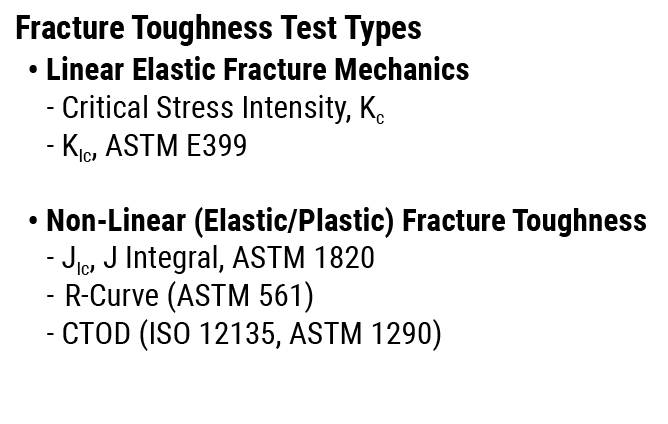
fracture toughness

Q: When would you use one fracture toughness test type over another?

A: It depends on the type of data you need and on the material. If you need a qualitative versus quantitative answer, then some of the simplest tests will be able to tell you whether the material is more or less susceptible to cracking. A simple test won’t tell you how much easier it is to crack the material, but the curve of a simple tensile test can tell you something. A Charpy impact test will tell you whether a material can withstand a force and give you pass/fail data. If you need a quantitative measurement, and you can get a valid test from a small specimen, you can try a KIc test, assuming that the material plasticity is minimal.

Q: What if the material plasticity is not minimal?

A: Sometimes conducting a valid KIc test would require a very large (and very expensive) specimen to ensure that most of the specimen is elastic. There is a solution to this problem: with a valid J Integral result, you can calculate the K value, allowing you to use a smaller specimen. Determining the J Integral requires more analysis, but because it is not dependent on the size of the plastic zone, it does not require the large specimen.

Q: What other considerations are there when choosing a fracture toughness test type?

A: As with all testing, consistency is important. Consistent notch type is important. Controlling the temperature, specimen geometry and thickness, and rate of loading are all requirements for a valid test result. Data collected from previous tests is a factor to consider as well. If you have a history of CTOD data, then it makes sense to choose that type of test.

Q: What about testing the fracture toughness of additively manufactured materials?

A: Additively manufactured materials are becoming more common, and they present several areas of concern: porosity, density and particle boundaries. Pores and boundaries in these materials act as cracks or notches, affecting the fatigue and fracture properties of the material. You must determine whether the "pseudo" notches cause cracks to grow catastrophically or not. Composites and additive manufactured materials present unique challenges in that they can have defects between the layers that we cannot see, so they must be tested.

Q: What else does the future hold for fracture toughness measurement?  

A: There will continue to be new ways to make materials like 3D printing/additive manufacturing; new materials like engineered composites; new uses for materials in things like hydrogen-fueled vehicles and space travel; and new testing techniques. All this innovation means that materials will need to be evaluated for fracture toughness to determine if they are appropriate for the intended end use. By understanding the principles and methodologies of fracture toughness testing, researchers and engineers can develop safer, more reliable materials and structures to meet the evolving needs of modern technology and industry.
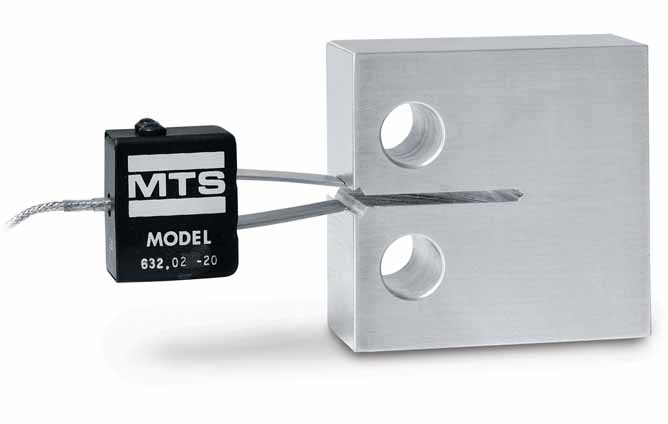
mts 632 クリップオンゲージ

Learn more about MTS' fatigue & fracture testing solutions

Fatigue & Fracture Solutions
Stay Connected

Lorem Ipsum Dolor

Lorem Ipsum Dolor

  • INDUSTRIES
  • SALES & SUPPORT
  • SUPPLIERS
  • ABOUT
  • APPLICATIONS
  • LEARN
  • CONTACT US
  • BUSINESS
We use necessary cookies to make our site work. We'd also like to set up optional analytics cookies to help us improve it. We won't set optional cookies unless you enable them.
Decline Accept
We use necessary cookies to make our site work. We'd also like to set up optional analytics cookies to help us improve it. We won't set optional cookies unless you enable them.
Decline Accept